.png&w=256&q=75)
Security by Design: Protecting Your Startup Data Before Day 1
By Ahmed Elsayed on January 27, 2026
Security by Design: Protecting Your Startup Data Before Day 1
When founders start building an app, their focus is usually on "Features" and "Design." Security often sits at the bottom of the list, or is postponed until "after launch." This procrastination is why 60% of small businesses that suffer a data breach go out of business within 6 months.
Customers might forgive a slow app, but they will never forgive a leaked phone number or credit card transaction.
What is "Security by Design"?
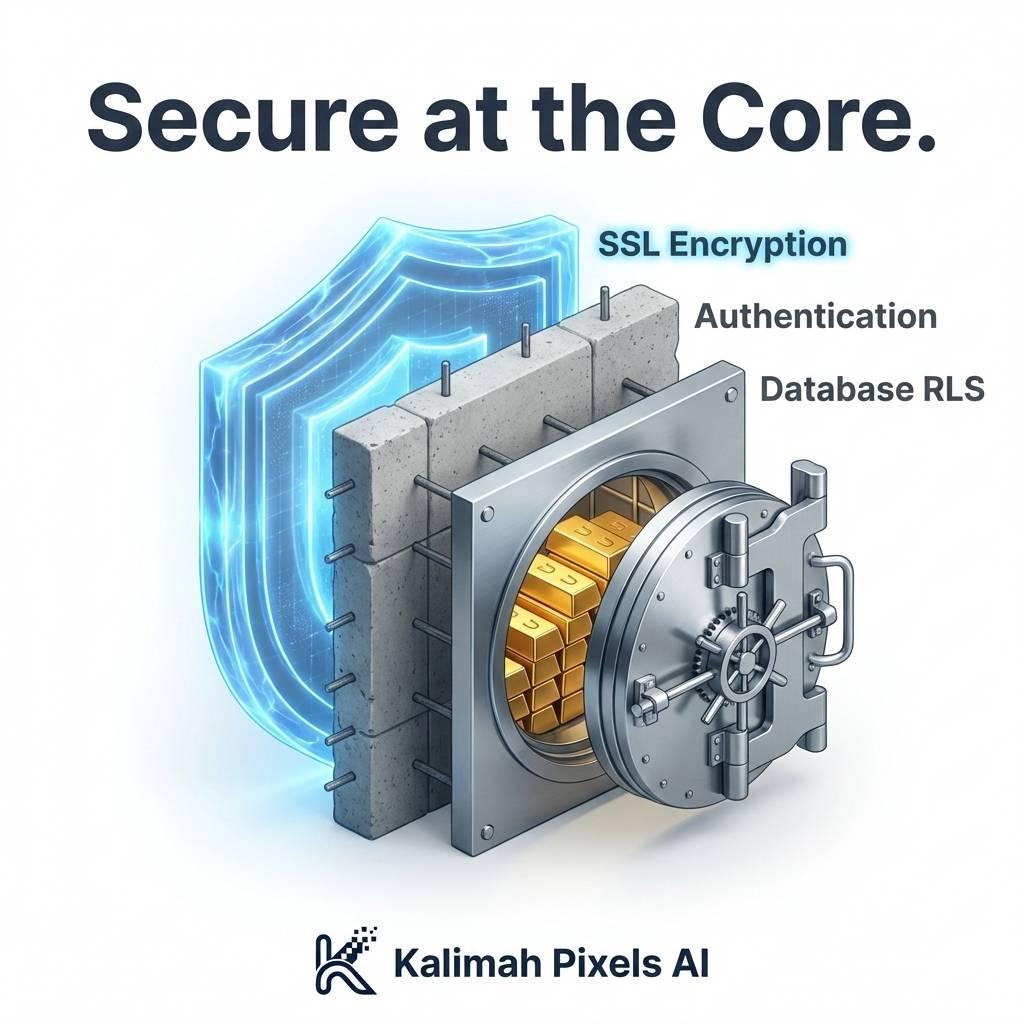
It is a software philosophy that means security isn't a "wall" we build around the app after it's done; it is the "building material" itself.
How We Apply This at Kalimah Pixels AI
We rely on Supabase as our backend, leveraging a powerful technology called Row Level Security (RLS).
1. What is RLS? And Why is it Genius?
In old systems, developers wrote logic in the app saying: "Please database, only give me this user's data." If the developer made a mistake in the code, the database might leak everything.
With RLS, the security rule lives inside the database engine itself.
- User "Ahmed" requests his data.
- The Database checks his ID and checks every single Row of data.
- If the row doesn't belong to Ahmed, the database acts as if it doesn't exist. This means even if there is a bug in the frontend app, the data remains locked.
2. Encryption Everywhere
We don't rely on luck.
- In Transit: Data is encrypted via SSL/TLS (The green lock in the browser).
- At Rest: Data stored on the server is encrypted (AES-256), so even if someone physically stole the hard drive, they would only see gibberish.
3. Legal Compliance (GDPR & PDPL)
In Saudi Arabia (PDPL) and Europe (GDPR), protecting data is a legal obligation. Our architecture ensures you are compliant with these laws, saving you from massive fines.
The Bottom Line: Protecting your users' data isn't a technical choice; it's an ethical and legal obligation. Build secure to stay secure.