.png&w=256&q=75)
What is Technical Debt? And Why It Could Bankrupt Your Startup Post-Launch
By Ahmed Elsayed on January 27, 2026
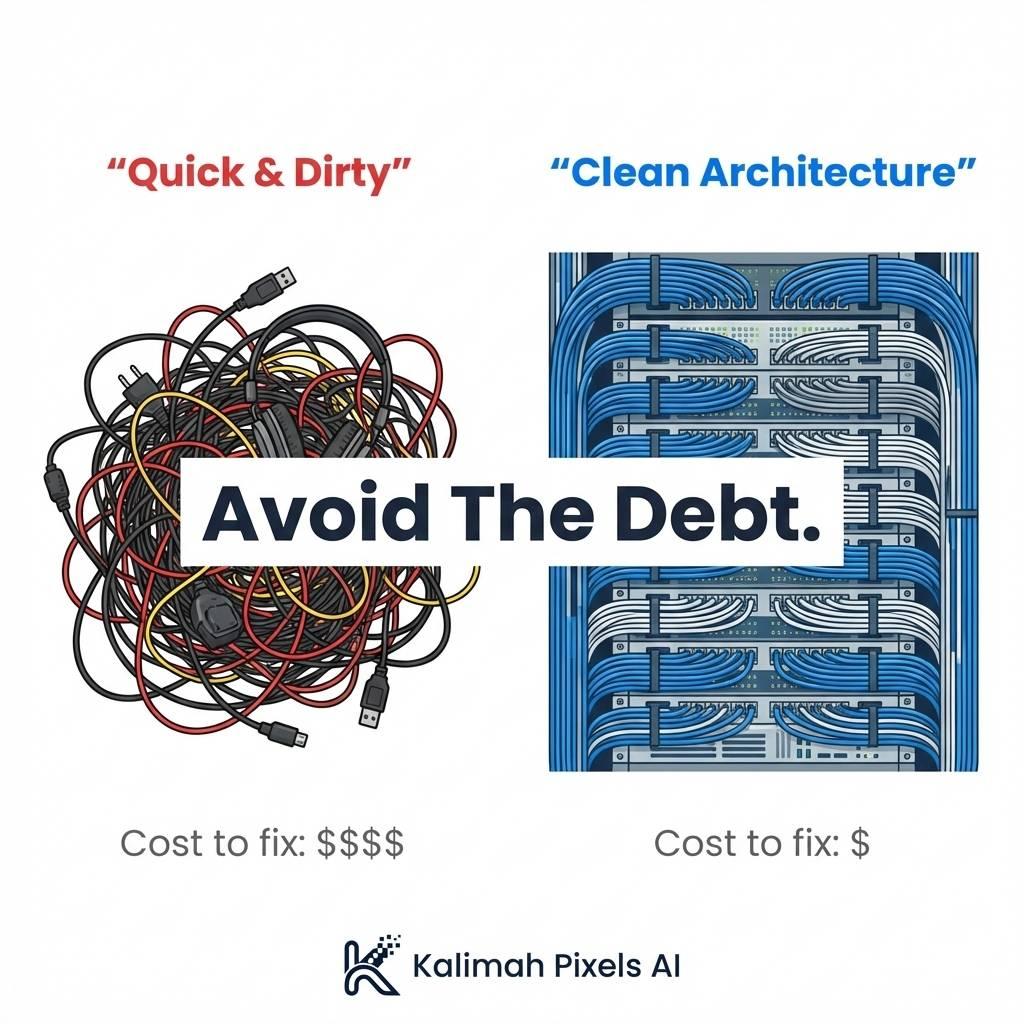
What is Technical Debt? And Why It Could Bankrupt Your Startup
Imagine building a house, and instead of laying a strong foundation, you decide to use cheap wood to finish fast and save money. The house looks great on move-in day, but with the first storm (user growth), the roof collapses.
This is Technical Debt.
How Does Technical Debt Happen?
It occurs when the tech team (or freelancer) decides to take shortcuts in coding to deliver the project quickly.
- Skipping code documentation.
- Copy-pasting duplicate code instead of creating reusable functions.
- Ignoring performance tests.
Why Is It Dangerous?
1. Compound Interest
Like financial debt, technical debt accrues interest. Every minute spent later trying to understand bad code or fixing bugs caused by it is "interest" you pay with your time and money.
2. Development Paralysis
Eventually, the code becomes so complex and tangled (Spaghetti Code) that adding a simple new feature takes weeks instead of hours, because the developer is afraid of breaking something old.
3. Scalability Blockers
Smart investors perform Technical Due Diligence. If they find your codebase is full of tech debt, they often walk away from the deal because they know they'll have to pay to rebuild the app from scratch.
How We Ensure "Zero Debt" at Kalimah Pixels AI
We follow the Clean Architecture methodology.
- Modularity: We break the app into small, independent units. If one part breaks, the rest stays alive.
- Standardization: We use global Flutter standards. Any professional developer can read our code and understand it immediately.
- Review: Not a single line of code (even AI-generated) passes without review to ensure quality.
The Bottom Line: Saving on code quality is an illusion. Pay now for a strong foundation, or pay double later to tear it down and rebuild.